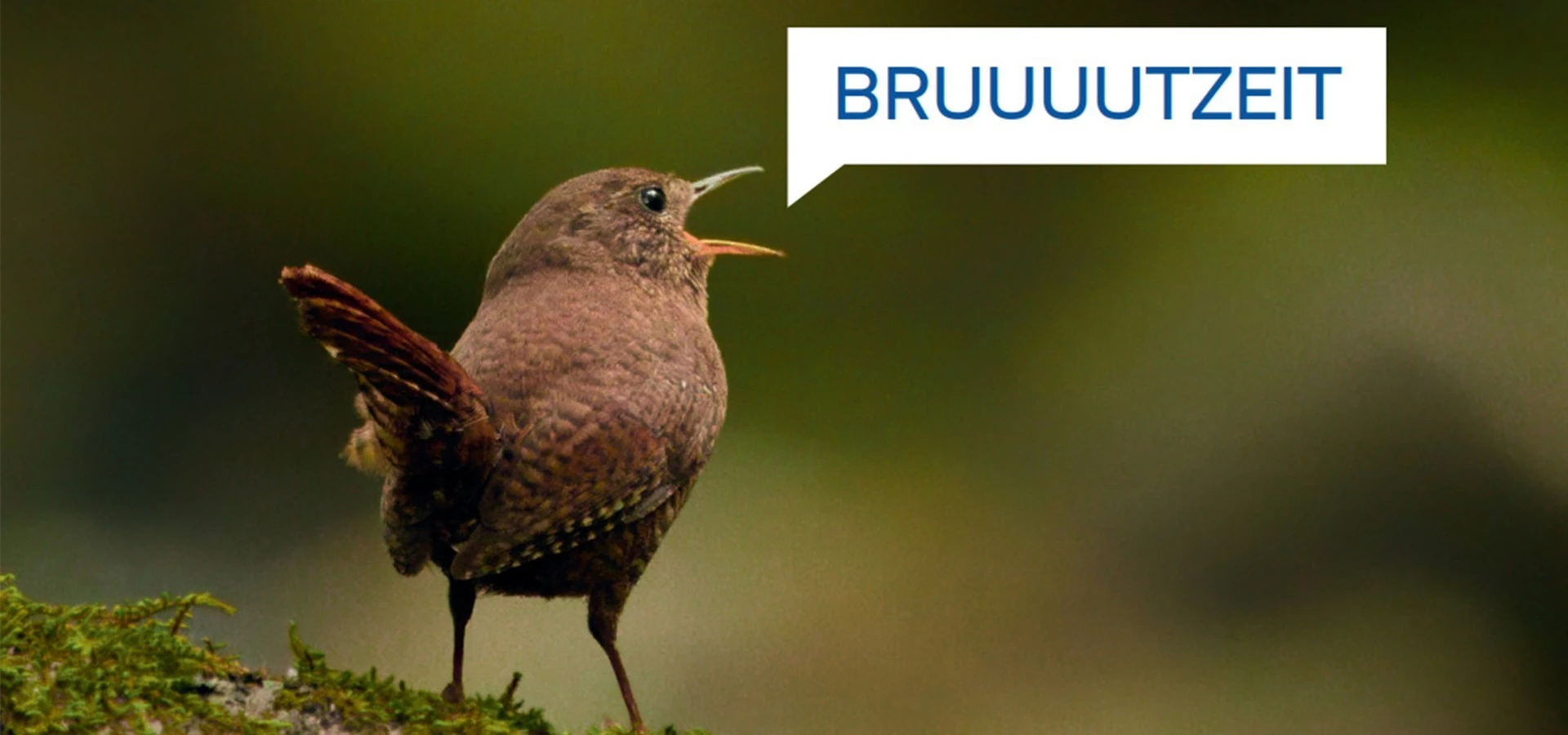
The birdsong is getting louder again - the breeding season is approaching!
Ornithologists survey the breeding sites and territories of specially protected bird species in the project area, particularly during the breeding and rearing phase. With the knowledge of the existing breeding sites and territories, as well as the expertise regarding the habitat requirements of these species, targeted measures are taken where necessary in terms of nature compatibility. To this end, the biologists from the 9-strong EWS team analyse the spatial use of bird species in the project area that are particularly worthy of protection and interpret their behaviour.
Christiane Steinbacher, EWS "Biology" team leader, explains: "Depending on whether the bird in the area is a breeding bird, a foraging bird, a flyover or a migrant, measures may be necessary to avoid and reduce the impact of the construction of the energy generation plant. We not only study birds of prey and falcons, but also carry out special surveys on woodcock, capercaillie, black grouse and hazel grouse, owls, nightjars, etc., depending on the area and altitude."
How does bird protection work with wind energy and (agricultural) photovoltaic systems?
Fundamentally, ornithological surveys for wind energy and large-scale solar projects differ in that only the construction phase and a breeding and rearing phase are usually relevant for solar projects, while the operational phase must also be considered for wind energy projects.
Wind energy projects require studies over two breeding and rearing periods and two winter periods to collect comprehensive data, particularly on birds of prey and large birds such as the red kite, black stork and imperial eagle in the project area. If the birds and their habitat requirements are known, targeted measures are taken to ensure an optimal mix of nature and project compatibility. For example, construction time restrictions can be agreed during the breeding season or a camera-based shutdown system can be installed, which takes the wind turbine out of the wind when a bird approaches.
A breeding and rearing period, which lasts from around the end of February to mid-July, is recorded and documented in the form of breeding bird mapping for large-scale (agricultural) PV systems. "Ground nesting birds play just as important a role as the so-called windbreaks, usually hedges and shrubs, in which birds also breed and raise their offspring and which are disturbed by construction activities or clearing during this sensitive phase," says EWS biologist Norbert Zierhofer. "We can counteract this with construction time restrictions and replacement reforestation."
Planning ecological surveys in good time
EWS biologists always coordinate the necessary measures closely with the "Approvals", "Technology", "Operations" and "Construction Management" departments. This allows scheduling processes to be planned in advance and the necessary steps to be optimally coordinated. This saves time, costs and unpleasant surprises.
This is why you should plan the necessary field surveys now and create a good database for your project in good time. Whether in flat northern Burgenland or in alpine terrain, with our expertise you are well prepared for the authorisation process.
Your contact at EWS:
Ing. Norbert Zierhofer, Bakk. techn. MSc
Managing Director of Commercial Law and Sales "Biology"
+43 664 24 91 281
n.zierhofer [at] ews-consulting.com