A Sleeping Beauty hedge instead of a fence
The expansion of ground-mounted photovoltaic systems often involves a balancing act between technical safety, agricultural use, the landscape and the preservation of ecosystems. Agri-PV systems such as our EWS Sonnenfeld® offer the opportunity to reconcile these differing requirements.
The process of establishing an open-space photovoltaic plant or an agri-PV plant is challenging. Depending on the location and design, approvals relating to electricity regulations, nature conservation and, where applicable, other requirements may be necessary. At the same time, technical and safety-related requirements must be taken into account. As photovoltaic systems can be operated at high direct current voltages, suitable safety concepts are necessary to protect people, animals and the system itself.
In the case of agri-PV systems, there is an additional key requirement: the land must remain suitable for agricultural use. The question of fencing should therefore not be answered in general terms. Rather, it is important to consider the actual protection needs of the specific system and to determine the necessary measures on a site-by-site basis. This requires cross-disciplinary solutions, and that is precisely our speciality.
One possible alternative to a continuous fence is, for example, a suitable hedge structure that can act as a natural barrier in the long term. A so-called ‘Sleeping Beauty hedge’ can combine several functions: it can make access to the installation more difficult, whilst at the same time keeping the landscape more open and ensuring better passage for wildlife than a continuous technical enclosure.
ASPECTS FOR A FENCE-FREE IMPLEMENTATION OF AGRI-PV SYSTEMS
- Agricultural use remains the priority:
The area appears less like a fenced-off energy park and more like what it actually is: land used for agriculture with additional energy generation. - A more open landscape:
A fence acts as an additional barrier and can further isolate a system from the surrounding landscape. Without continuous fencing, the installation appears less dominant and blends in better with the existing cultural landscape. - Better access for animals:
A continuous fence can restrict the movement of wildlife and disrupt migration corridors. Without fencing, animal movement remains possible in principle. A suitable hedge can fulfil both a protective and a demarcating function. - Less technical intervention and use of materials:
Fences, posts, gates and the associated maintenance can be dispensed with. This reduces the use of materials and minimises additional technical intervention in the area. It should be borne in mind, however, that temporary protection against wildlife browsing may be necessary, particularly whilst a hedge is establishing itself. - Natural integration:
A hedge planned to suit the site can not only serve as a barrier but also create ecological added value. Depending on their design, wooded structures can provide habitat and food sources for various animal species.
NO FENCE IS NOT THE STANDARD – BUT A SITE-SPECIFIC DECISION
‘No fence’ is not necessarily the better solution. For every site, factors such as the risks of theft and vandalism, electrical safety requirements, liability issues, animal husbandry, agricultural management and regulatory requirements must be taken into account.
It is therefore crucial to carry out an individual assessment of the actual need for protection. However, where the technical, legal and safety-related conditions are met, foregoing continuous fencing can represent a sensible alternative.
A suitable hedge structure can reconcile various interests: it can provide the necessary demarcation without completely sealing off the landscape, preserve animals’ freedom of movement and, at the same time, visibly emphasise the agricultural use of the land.
In this way, traditional technical fencing can be transformed into a natural solution that combines energy generation, agriculture, the landscape and ecological connectivity.
Alina Mirwald: “From a project development perspective, agri-PV is not about erecting as many installations as possible according to a standardised model. Each site has its own specific conditions, which must be taken into account in the planning from the outset. This also includes the question of whether fencing is actually necessary. Where it is technically, legally and in terms of safety feasible, we see fence-free concepts as an interesting alternative. A suitable hedge structure can provide protection and demarcation without completely isolating the area from the surrounding landscape. For us, therefore, good project development means not only optimising energy generation, but also developing solutions that combine agriculture, safety, landscape and nature as effectively as possible. This is the basis for every EWS Sonnenfeld® that we have the privilege of realising.”
Agri-PV does not have to choose between agriculture and energy. It can do both. Our EWS Sonnenfeld® combines the two – whilst leaving room for nature.
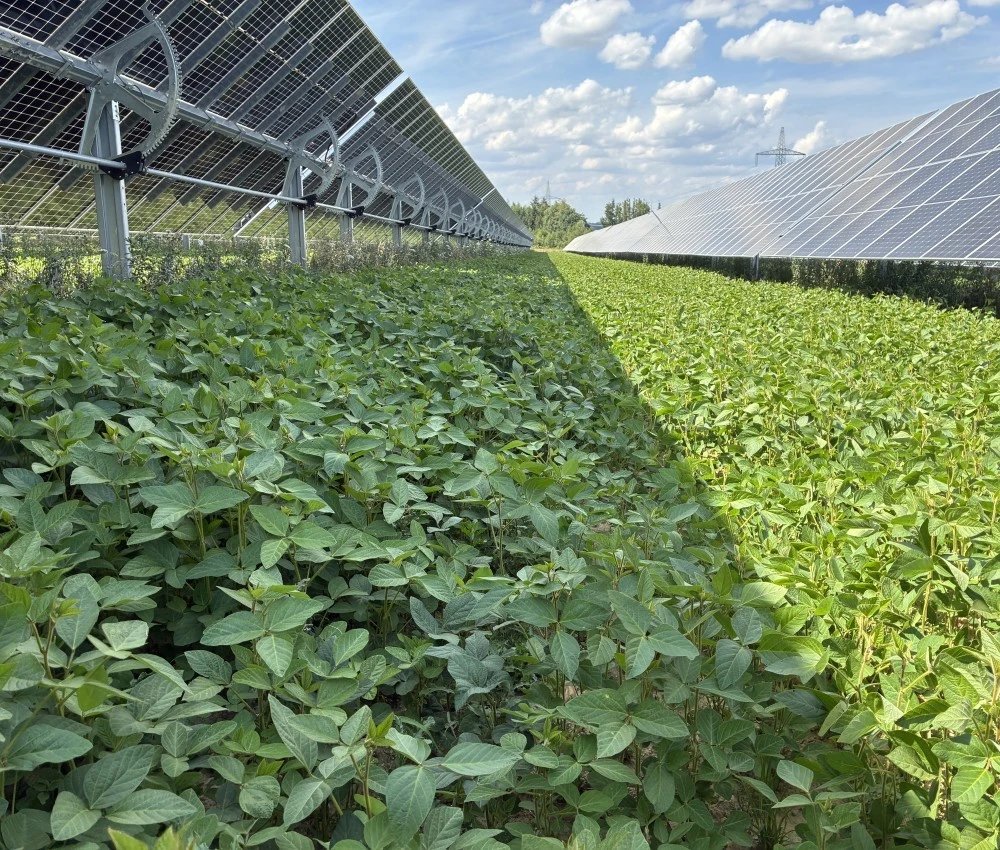
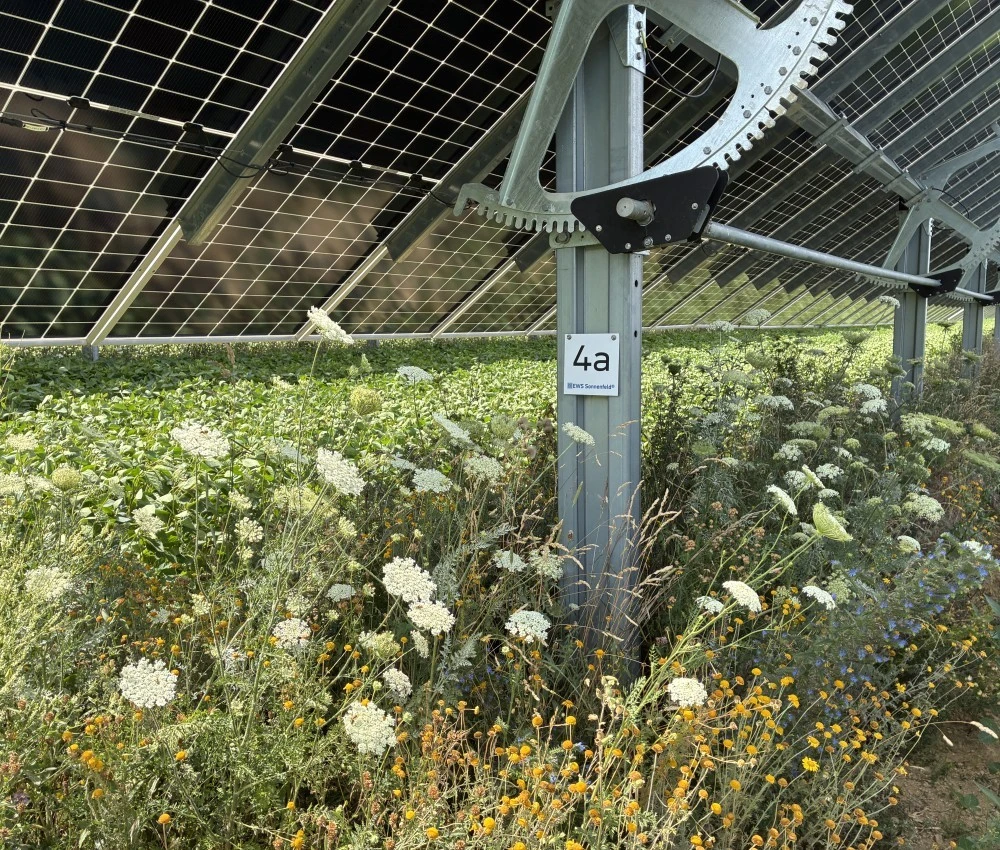
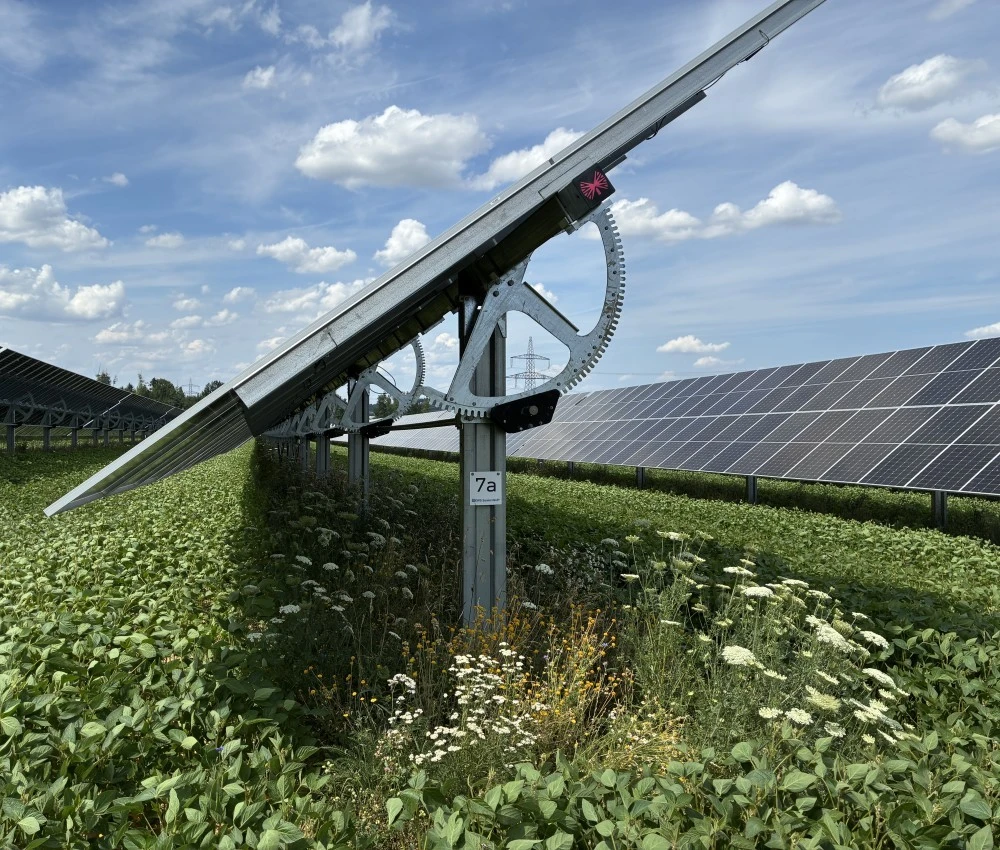
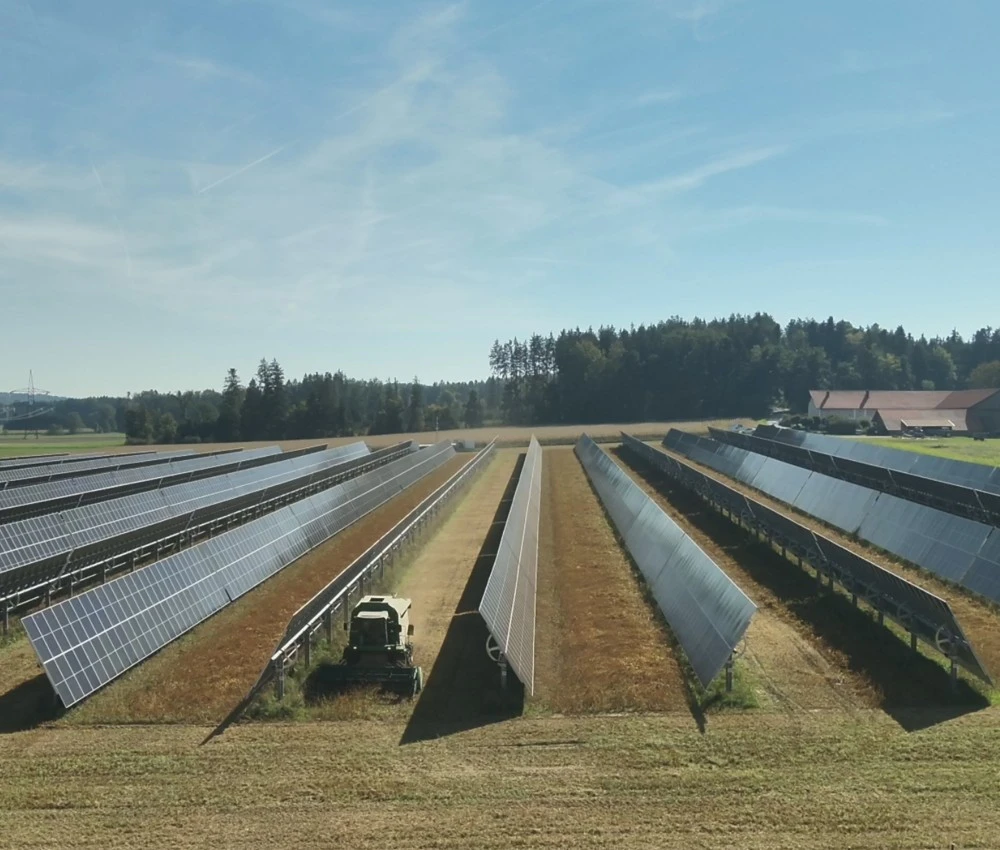
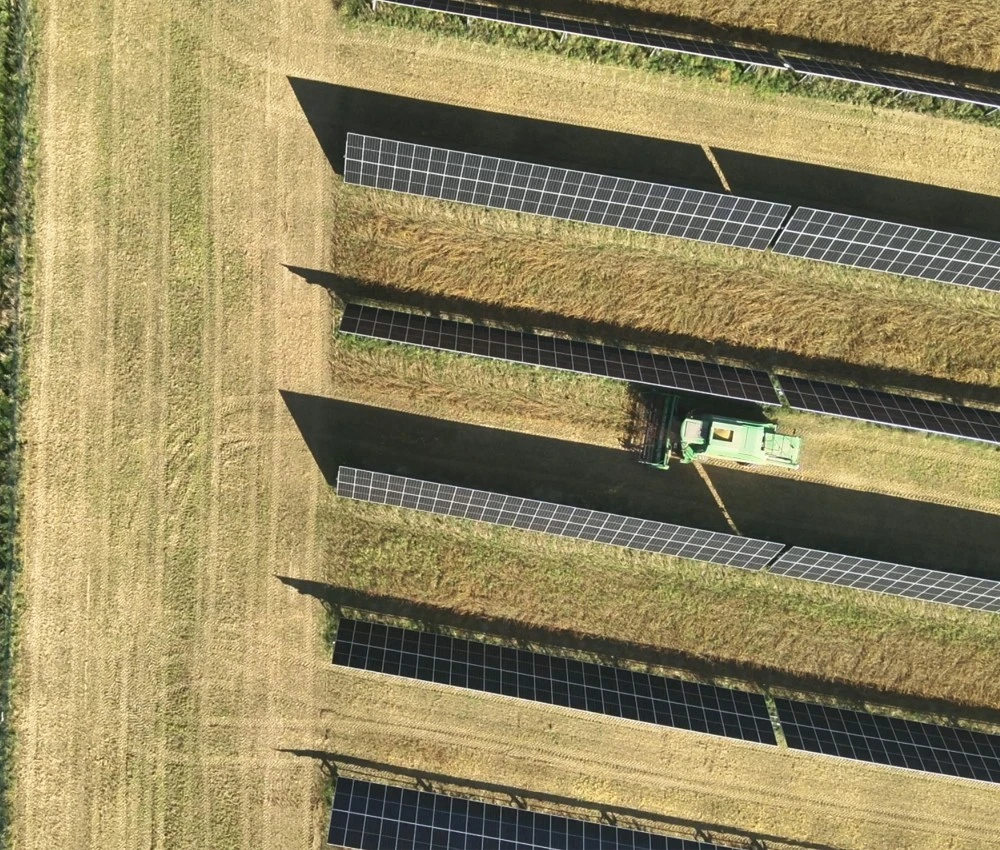
One example of this is the EWS Sonnenfeld in Pischelsdorf am Engelbach. The photos show how well the soya and wildflower strips have grown there. The harvest took place on 29 September.