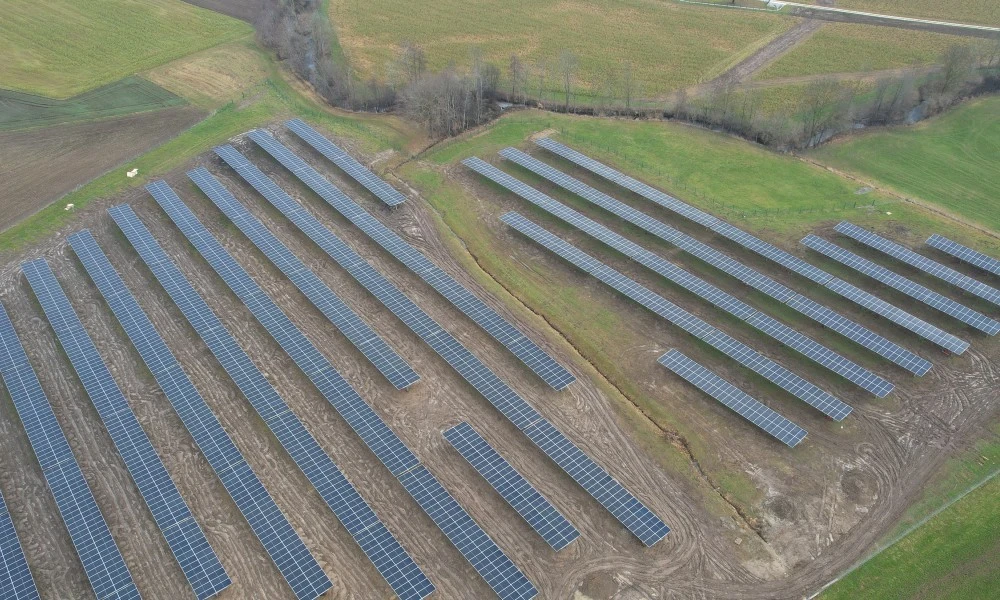
Yield forecasts for PV parks and solar systems
PV yield forecast: we simulate the expected annual yield of your PV park as a basis for planning, financing and operation.
Reliable yield forecasts are the basis for sound planning, financing and the long-term successful operation of your PV park. We determine the expected energy yields using simulation methods and site-specific data. In doing so, we take into account long-term meteorological data, shading analyses, module orientation and tilt, as well as system technology and system losses.
A yield forecast answers the question of how much electricity your PV system is expected to generate per year. This figure influences revenues, profitability and financing conditions. The starting point is irradiation data over many years, because solar irradiation fluctuates from year to year. Public databases such as PVGIS provide hourly radiation values for this. The simulation converts them into a yield using module temperature, horizon and shading, with temperature and irradiation effects differing depending on the module technology. The mounting type is also factored in: fixed-tilt, tracking or vertical bifacial modules change the yield profile over the day and the year. A forecast is only as good as its input data: the more precisely horizon, module layout and system technology are known, the narrower the uncertainty can be kept.
Less remains of the theoretical yield after deducting losses: inverters, cables, soiling, temperature and the annual ageing of the modules (degradation) reduce generation. Banks and investors therefore expect not a single value but probabilities. The P50 value is reached or exceeded with a probability of 50 per cent, the more conservative P90 value with 90 per cent. The better site, shading and system losses are modelled, the more reliable the statement is for banks and investors. In operation, the forecast serves as the target value for comparison with measured data; for the monitoring of PV systems, IEC 61724-1 is the benchmark. The overall uncertainty is made up of several individual items, such as the radiation data, long-term variability, module performance and the simulation model. In economic calculations, modules are often assumed to run for around 30 years, so even a small annual degradation affects the total yield.
By comparing different scenarios, you get a transparent assessment of the yield opportunities and risks of your project. Comparisons can include system variants with different orientation, tracking or row spacing, as well as additions of battery storage; for agri-PV, the shading of crops is added. The funding option, that is investment grant or market premium, also changes revenues. The overall picture serves banks, investors and permitting authorities as a basis for investment decisions. Beforehand, the feasibility studies with layout plan clarify the system design. The investment and operating cost plan sets the costs against the revenues, and for participation models, citizen participation is added. For funded projects, we support the handling of the funding application, and for wind farms we prepare the review report on wind potential and yield.