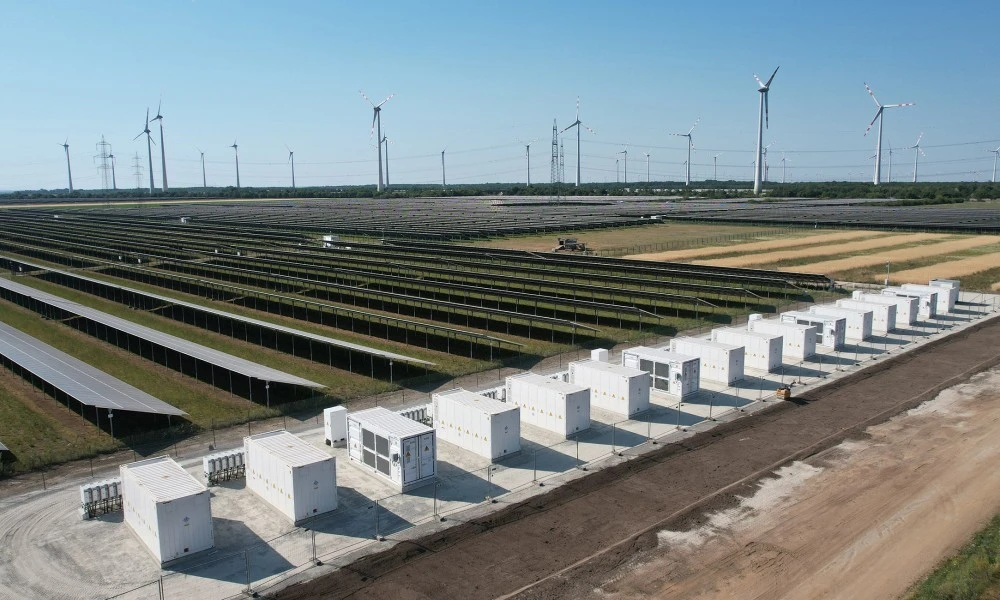
Procurement and delivery of battery storage systems
Battery storage procurement and delivery: we coordinate storage technology and delivery and implement your project as a complete package.
Battery storage is a central building block of a sustainable energy supply. That is why we implement your energy storage projects as a comprehensive complete package. We coordinate the procurement of innovative storage technologies and ensure their delivery. In doing so we take current market availability into account as well as technical developments, and rely on high-quality components, experienced partners and precise, reliable implementation.
Procurement involves more than the cell price. A large-scale storage system consists of battery cells and racks, a battery management system, inverters, transformers, a higher-level energy management system and the enclosure, usually an air-conditioned container with fire detection. Safety behaviour differs depending on cell chemistry: lithium iron phosphate cells often show higher thermal stability than nickel manganese cobalt cells; however, safety behaviour also depends on the design of the cell, module and system. Safety evidence such as test reports under UL 9540A or IEC 62619 belongs in every supply specification, because the results on fire propagation and thermal radiation that manufacturers determine in full-scale fire tests are inputs for the project-specific fire protection concept and for determining the distances in the storage park. The battery management system provides protection against external short circuit, overcharging, deep discharge and overtemperature, and the power electronics are designed to the relevant safety standards. Economically, the operating mode counts: storage serves self-consumption optimisation, optimisation of grid feed-in and grid support through load shifting and flexibility balancing.
The type of coupling is also important. Whether a storage system is AC-coupled or DC-coupled, and whether it is connected to the grid on its own or together with a generation plant, determines the choice of components, the grid connection and the legal classification. The grid operator requires information on number, rated apparent power and capacity in kWh, on the coupling type and on the operating mode, such as covering own demand, grid feed-in or island operation; these should be fixed when selecting the system. In terms of timing, the grid connection counts: the requirements and timing for reserving grid connection capacity depend on the legal situation in force and the connection rules of the respective grid operator, which can affect the sequence of ordering and permitting. Transport dimensions go up to the size of a sea container of around 6.1 × 2.4 × 2.9 metres and shape delivery and access. Fan output, and with it noise emission, depends on the outside temperature, and manufacturer data later serve as the emission basis in the noise assessment; both are to be considered when selecting cooling and siting.
There is also a good deal to note on the regulatory side. For industrial batteries above 2 kWh, the battery passport is added from 18 February 2027, an electronic record with model and usage data provided via a QR code; the EU Batteries Regulation also governs labelling, declaration of conformity and the safety of stationary storage systems. It is advisable to involve the insurer early and to provide an IT security concept for the energy management system. Whether as a complement to your PV plant, for peak shaving or to optimise self-consumption: we supply storage solutions tailored to your requirements. Upstream is the tender for storage components; building on that, we take over turnkey installation of battery storage. Operations on site are managed by construction site coordination. For photovoltaics there is procurement and delivery of PV plants.